The laptop can be closed, and our mind can still be working.
The calendar can be clear, and our body can still feel stressed. The room can be quiet, and our nervous system can still be listening for what might be asked next. We may have an evening open, a day off, a few hours without a visible demand, and instead of feeling restored, we find ourselves searching for what still needs to be handled.
From the outside, rest appears available. No one may be calling. The task may be done for now. The meeting may be over. The house may be still. The responsibility directly in front of us may have been completed. Internally, though, rest may not have arrived.
Our mind may still be moving through unresolved details. Our nervous system may still be scanning. Our body may still be carrying the pace of what came before. Our emotions may begin surfacing what movement helped us postpone. And our consciousness may recognize, even faintly, that we are not fully present inside the pause we have been given.
This can be confusing because we tend to think rest begins when activity stops. But stopped movement and received rest are not the same experience.
When the Outer World Slows Before the Inner World Does
A conversation can be over while our nervous system continues processing what was said, what was not said, what was contained, what we wish we had expressed differently, and what we may still need to protect against. A responsibility can be completed while our body remains tense, as if capability still has to be proven through readiness. A quiet room can be available while quiet itself feels uncomfortable rather than spacious.
This is where the gap begins to show itself. Rest may be available around us, but not yet accessible within us. Available rest means there is space. Accessible rest means our mind, nervous system, and body can enter that space without treating it as risk, absence, uncertainty, disconnection, or loss of protection.
When Movement Has Been Our Proof
Rest asks more from us than we may realize. It asks us to stop using movement as proof that we are okay. It asks us to stop using usefulness, performance, caretaking, readiness, responsiveness, productivity, or control as evidence that we are safe, valuable, needed, prepared, or still holding everything together.
That can be a lot to release when those patterns have carried us through life. For some of us, movement has helped us to belong. Being useful helped us stay connected. Being prepared helped us feel less exposed. Being responsive helped us avoid conflict. Being capable helped us receive approval. Being the one who kept going became part of how others understood us, and eventually part of how we understood ourselves.
So, when rest becomes available, it may not feel like care. It may feel like interruption. It may feel like falling behind. It may feel like becoming unavailable to the people who depend on us. It may feel like losing control of what we have been tracking. It may feel like stepping away from the version of our Self that others know how to rely on.
And when rest feels this way, the difficulty is not simply that we are too busy, too driven, or too distracted. The deeper pattern may be that our mind, nervous system, and body have learned to associate safety with remaining in motion.
Rest as a Relationship
Rest is not only a biological need. It is also a learned relationship. And for most of us, rest may carry a different histories.
Stillness may have been imposed rather than received. Quiet may have meant being sent away, silenced, controlled, or separated from connection. Pausing may have felt like losing control. Not doing may have felt like not mattering. Rest may have become something we earn only after everything is handled, after no one needs us, after we have done enough.
And life rarely completes itself cleanly enough for rest to arrive through those conditions. So, the question becomes less about why rest is difficult and more about what our internal world has learned, rest might cost us.
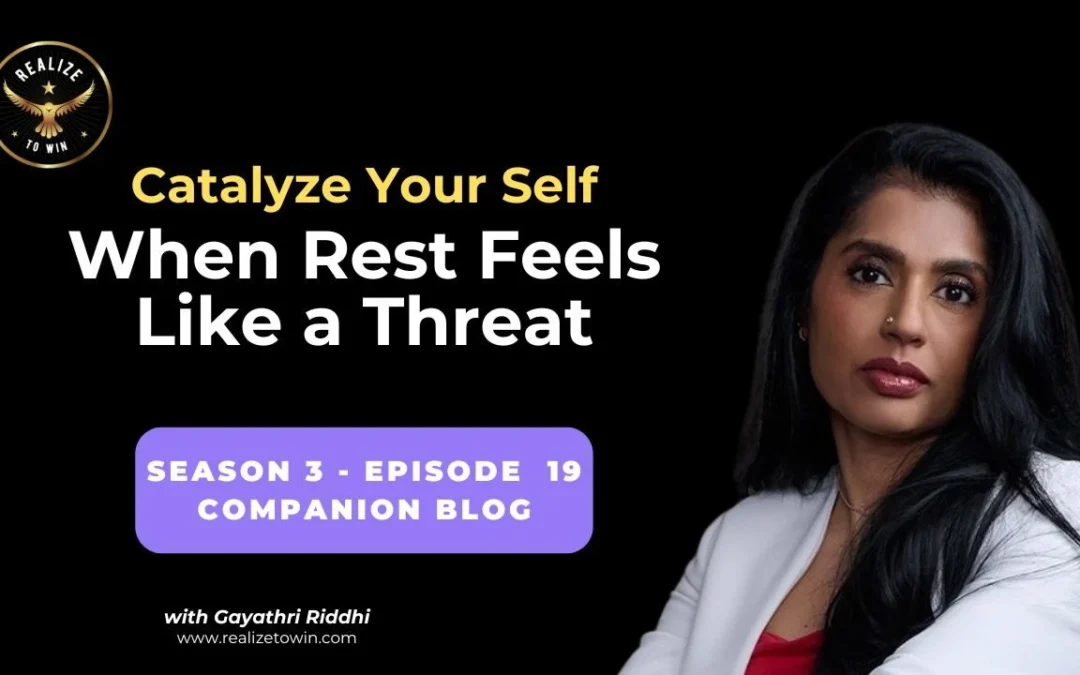
In Catalyze Your Self, Season 3 Episode 19, “When Rest Feels Like a Threat,” we stay with this conditioned relationship more closely.
The episode explores what may be happening inside our mind, nervous system, body, cognition, emotion, and consciousness when rest is available around us but not accessible within us.
It stays with why tiredness does not automatically lead us into rest. Tiredness may be the signal, but rest is the relationship. And when that relationship has been shaped by vigilance, usefulness, identity, responsibility, control, guilt, or shutdown, our mind, nervous system, and body may need something more honest than pressure to relax.
The episode also brings this into relationship with The SIRE Model™ through HALT, especially the T of Tiredness, as a way of noticing when our internal range has narrowed and something within us is asking for attention.
A Reflection
Our invitation here is to notice what happens within us when rest becomes possible.
When rest becomes available, does our internal world know how to enter it?
When tiredness appears, do we listen to it, override it, manage it, justify it, or wait until shutdown takes over?
What has our mind, nervous system, and body learned rest might cost us?
Where has usefulness become tied so closely to worth that pausing feels like losing our place?
Where does quiet feel spacious, and where does it still feel like exposure?
And what might begin to change if rest were not treated as something we have to earn, force, optimize, or perform, but as one of the ways we return to our own Self?
Listen to the full episode of Catalyze Your Self, Season 3 Episode 19: When Rest Feels Like a Threat.
Spotify: https://open.spotify.com/episode/0bkAI19lHsRkidSbzUnoxp?si=rjJvfQ19RZ6wfbMpJ1CRSQ
Apple: https://apple.co/4dDwqfe
YouTube: https://youtu.be/gjlM0VQU3yk