Now available for purchase! Self-Intervention for Conscious Leadership, a guided, personalized experience to strengthen how you lead under pressure. See What’s Included
The Superpower of Self-Reflection: Grow By Returning to Yourself

The Superpower of Self-Reflection: Grow By Returning to Yourself

The Superpower of Self-Reflection: Grow By Returning to Yourself

If you’ve been walking alongside me this season on Catalyze Your Self, you’ve seen something take shape, not just a framework for leadership, but a full, lived ecosystem for growth. We began with awareness. We layered in emotional intelligence. We moved through HALT, RISE, and SHIFT. And now, we land in a space that is quiet… but foundational: Self-Reflection.

Because growth isn’t just about knowing what to do, it’s about staying in relationship with what you’ve learned. That’s where transformation happens. Not in a single insight. But in your return to insight, over and over again.

Why Reflection Is the Real Game-Changer

Self-reflection is not rumination. It’s not obsessing over your choices or replaying conversations in your head. True reflection is presence. It’s when you pause long enough to ask:

  • “What’s unfolding in me right now?”
  • “Is this reaction aligned with who I’m becoming?”
  • “Do I want to keep choosing from this place?”

In this episode, I share how self-reflection holds together the core system of the SIRE Model™ (Self-Awareness, Self-Inspiration, Self-Regulation, and Self-Expression) and keeps those practices alive in your day-to-day life. Because insight is only powerful when you stay in relationship with it.

Reflection Isn’t Extra, it’s Essential

Without self-reflection:

  • Self-awareness becomes reactive.
  • Self-inspiration gets dimmed by urgency.
  • Self-regulation becomes occasional.
  • Self-expression drifts into performance instead of truth.

With reflection, though, each element becomes durable. Integrated. Aligned. And that’s how your growth becomes sustainable.

When self-reflection is integrated into your way of living:


  • HALT becomes meaningful when we reflect on what’s beneath our hesitation or over-functioning.
  • RISE gains depth when we ask, “What intention am I bringing into this moment?”
  • SHIFT becomes natural when we’ve practiced noticing: “Is this reaction from presence… or pattern?”

This episode walks through how self-reflection transforms these tools from actions to embodiment  with a glimpse into what it looks like in real life.

Reflection doesn’t have to be a journal or meditation. It might be:

  • A pause at the kitchen sink when your chest feels tight.
  • A question you ask between meetings: “Am I moving from alignment right now?”
  • A call you give yourself: “That version of me, the one who said yes out of pressure today, isn’t who I want to be tomorrow.”

Your Call to Reflection

This week, I invite you to begin where you are. Just one check-in a day. Ask:

  • “What am I feeling right now?”
  • “What part of me is leading?”
  • “Is this choice coming from presence… or from habit?”

You don’t need more time. You need more intention inside the time you already have.

Listen to the full episode of the Superpower of Self-Reflection wherever you enjoy your podcasts. You’ll learn how to bring quiet clarity into busy moments and how that simple act can shift everything.

Next week in Episode 14, we explore Aligning Head & Heart, a conversation about integrating cognition, emotion, and deeper awareness into a shared, congruent inner world.

Until then, reflect gently. Stay curious with yourself. And continue to catalyze your self.

Conscious Leadership: Influence That Begins Within

Conscious Leadership: Influence That Begins Within

Conscious Leadership: Influence That Begins Within

If you’ve been journeying through this season of Catalyze Your Self, you’ve likely noticed the shift, from inner awareness to intentional action. In recent episodes, we explored conscious presence, emotional intelligence, and choice as gateways to inner peace and alignment. This week, we step into the natural evolution of that work: Conscious Leadership.

Because leadership doesn’t begin when you’re given a title, it begins when you take ownership of how you show up. In your conversations. In your energy. In how you handle conflict, pressure, or complexity.

Leadership is not something you do. It’s something you are, when you lead from within.

Presence Is Your Power

Conscious leadership isn’t about charisma, performance, or perfection. It’s about presence. It’s about how well you know yourself, inspire yourself, regulate yourself, and express yourself, especially in moments that feel messy, uncertain, or emotionally charged.

In this episode, I show how the SIRE Model™ becomes your anchor:

  • Self-Awareness: Noticing your internal world before it leaks into the room.
  • Self-Inspiration: Leading from purpose, not pressure.
  • Self-Regulation: Choosing pause over reactivity.
  • Self-Expression: Communicating with clarity, compassion, and congruence.

When these four elements come alive in you, leadership becomes something others feel, not because you demand authority, but because you embody alignment.

Leading Real Moments

We revisit the power of HALT, RISE, and SHIFT, the three supportive frameworks that give action to SIRE, and we walk through what it looks like to lead through them in real time.

Imagine walking into a team meeting where tension is high and silence fills the space. Instead of reacting from urgency or frustration, conscious leadership asks:

  • Am I in a HALT state right now?
  • Can I RISE and create space for the team to reflect and reconnect?
  • Can we SHIFT together, from misalignment to mutual clarity and trust?

These are not just leadership tools. They are leadership rhythms. And when practiced consistently, they change the emotional climate of your team.


You Become the Culture

As a conscious leader, you set the tone. Not through control, but through clarity. Not by fixing others, but by modeling steady, grounded presence.

In this episode, I share insights from my coaching work, how leaders shifted team dynamics, not by having all the answers, but by staying deeply aligned with themselves. Their inner steadiness became their team’s anchor.

This is the ripple effect of real leadership. When your presence feels safe, others feel safe enough to be honest, to engage, and to grow.

Your Call to Action

This week, I invite you to reflect:

  • Where are you leading from reaction, and where are you leading from intention?
  • What part of The SIRE Model™ is most active for you right now, and what part could use more support?
  • Can you use HALT, RISE, or SHIFT the next time tension arises, with your team, your family, or yourself?

If this episode resonated, I encourage you to listen fully to Conscious Leadership, available now for you to tune in. This is more than a leadership strategy. It’s a way of living and leading that starts from within and transforms everything around you.

Next week in Episode 13, we’ll explore the Superpower of Self-Reflection, and how consistent, quiet reflection becomes the bridge between who you are and who you’re becoming.

Until then, lead gently. Lead intentionally. And continue to catalyze your self,  one moment, one decision, one breath at a time.

Conscious Presence & Peace: The Practice of Inner Leadership

Conscious Presence & Peace: The Practice of Inner Leadership

Conscious Presence & Peace: The Practice of Inner Leadership

If you’ve been walking with me through this season of Catalyze Your Self, you’ve seen how we’ve moved from the building-blocks of thought and emotion into the deeper, layered work of self-leadership. We’ve explored cognition and emotional intelligence, awakened our awareness, and reclaimed our ability to choose. This week, we step into the heart of that work: the practice of conscious presence, and the peace that flows from it. Because peace is not the absence of pressure. It’s the presence of alignment. 

Peace Isn’t Passive. It’s Practice

Peace of mind isn’t about avoiding challenges or perfecting your environment. It’s what happens when your cognition, emotion, and consciousness are no longer in conflict with one another, when your thoughts aren’t at war with your feelings, and your awareness holds them both with steadiness.

Your presence is the gateway. Peace is what meets you when you walk through it.

In this episode, we ground into the truth that peace is not a performance, it’s a practice. It lives in your ability to recognize, regulate, and return to yourself, over and over again.

HALT, RISE, and SHIFT: Bringing the SIRE Model™ to Life

Earlier in the season, we explored The SIRE Model™ (Self-Awareness, Self-Inspiration, Self-Regulation, and Self-Expression) as the foundation of conscious leadership. This week, we introduce the three supporting frameworks that bring this model into motion:

  • HALT is the signal; it shows you where you’ve drifted.
  • RISE is the rhythm; it brings you gently back into presence.
  • SHIFT is the integration; where awareness becomes action and peace becomes practice.

This episode walks through how each framework supports your self-leadership:

  • HALT shows you the subtle disruptions to your presence: Hesitation, Avoidance, Lack, and Tiredness.
  • RISE reconnects you through Recognition, Intention, Senses, and Evaluation, allowing your nervous system and awareness to realign.
  • SHIFT gives you the moment-to-moment guidance to Stop the pattern, Highlight what’s real, Integrate the insight, Flow with presence, and Trust yourself through it.


Together, these aren’t just practices, they’re a way of being. One that supports presence not as something you visit, but as a place you live from.

Conscious Presence in Real Life

What does this look like in practice? It looks like pausing before a difficult conversation to breathe, check in, and choose your tone with intention. It looks like noticing that you’re drained before a meeting, and using HALT to name the tiredness, then RISE to reconnect with your purpose before you engage. It looks like using SHIFT to stop a reaction mid-pattern, highlight what’s really driving it, and re-enter the moment grounded in clarity instead of urgency.

This isn’t perfection. It’s presence.

This week, I invite you to reflect:

  • What signal from HALT do you most often miss?
  • Where could you RISE, not in productivity, but in self-connection?
  • What would it look like to SHIFT, even gently, when you feel off center?

Let these frameworks, and the deeper self-leadership you’ve cultivated this season, support you in practicing presence. Not once. But again, and again. With gentleness, with grace, and with growing trust in who you are becoming.

Want to deepen this work?

Listen to the full episode of Conscious Presence & Peace wherever you enjoy your podcasts. You’ll walk away not just understanding peace, but knowing how to return to it, lead from it, and live within it.

Next week, we expand even further into Conscious Leadership, exploring how the presence you’ve built becomes the power you bring to others.

Until then, stay aware. Stay anchored. And keep returning to peace, one breath, one choice, one moment at a time.

When Coping Becomes the only Option

When Coping Becomes the only Option

When Coping Becomes the only Option

Coping can hide inside the most acceptable versions of ourselves.

It can hide inside responsibility. Inside preparation. Inside productivity. Inside composure. Inside strength. Inside being the person who knows how to keep going when life is asking too much. This is part of what makes coping difficult to recognize while we are inside it.

Our behavior may not look concerning. It may even look admirable. We may be handling what needs to be handled. We may be calm on the outside. We may be staying useful, steady, responsive, capable. We may be doing what others depend on us to do.

And still, something inside us may have shifted. The question is not simply, what are we doing? The deeper question is, what inner condition is choosing it?

Because the same behavior can come from very different places within us. Preparation can come from alignment, and preparation can also come from the discomfort of uncertainty. Productivity can come from purpose, and productivity can also come from not wanting to feel what stillness may reveal. Calm can come from grounded presence, and calm can also come from muting the signal before anyone else can see it.


When functioning is not the same as being present

When pressure continues long enough, coping can begin to feel less like one response among many and more like the only path available. Our mind has less room to process. Emotion may be present but not fully welcomed. The nervous system begins looking for predictability, distance, relief, or some way to lower the demand of the moment. The body carries what the mind has not yet been able to process. Consciousness, the part of us that can observe the whole of what is happening, has less room because so much attention is being used to keep functioning.

This is how coping can become convincing. It may help us stay in the room. Stay in the role. Stay with responsibility. Stay with the day. Stay with the people depending on us. Stay functional when the fullness of what we are carrying has not yet had room to be acknowledged.


The inner condition beneath the behavior

Coping is not always visible from the outside. From the outside, control can look like being prepared. Productivity can look like discipline. Emotional suppression can look like maturity. Avoidance can look like timing. Numbing can look like rest. People-pleasing can look like kindness. Withdrawal can look like needing space. Defensiveness can look like confidence. Comparison can look like perspective. Fantasy can look like hope.

The outer behavior alone does not tell the full story. The inner condition does.

Control may be trying to reduce uncertainty. Productivity may be trying to reduce contact with what we feel. Emotional suppression may be trying to reduce relational disruption. Avoidance may be trying to reduce the consequence of facing what is present. Numbing may be trying to reduce sensation. People-pleasing may be trying to reduce the fear of rejection or misunderstanding. Withdrawal may be trying to reduce relational demand. Defensiveness may be trying to reduce shame or vulnerability. Fantasy may be trying to reduce the weight of the current life.

So, we must ask ourselves, What is this coping response trying to reduce? That question changes the entire relationship with the pattern. It keeps us from shaming the behavior. It keeps us from pretending the behavior has no cost. It allows us to listen beneath the pattern and notice what our mind, nervous system, body, emotion, and consciousness have been trying to protect us from.


When coping starts narrowing our life

Coping can protect us and still cost us. It can help us stay functional and still distance us from inner truth. It can help us preserve connection and still quiet our own voice. It can help us keep moving and still keep us from noticing how tired we have become. It can help us stay composed and still keep us from receiving care. It can help us feel safe and still keep us living inside a role that no longer reflects who we are becoming.

Coping can create distance. Distance from what we feel. Distance from what we know. Distance from what we need. Distance from the body’s signals. Distance from the present moment. Distance from the part of us that can still choose from alignment when enough inner space is available.

And because coping can be rewarded, the distance may grow quietly. Others may praise our strength. Depend on our steadiness. Benefit from our helpfulness. Trust our competence. Expect calm. Admire our ability to keep going.

Meanwhile, internally, we may sense something different. A heaviness after we say yes. A disconnection after we stay composed. Fatigue beneath the productivity. A quiet resentment after keeping peace. A numbness that looks like rest but does not restore us.

These signals may be showing us that coping has moved from occasional support into a primary way of navigating pressure.


Why recognizing coping matters

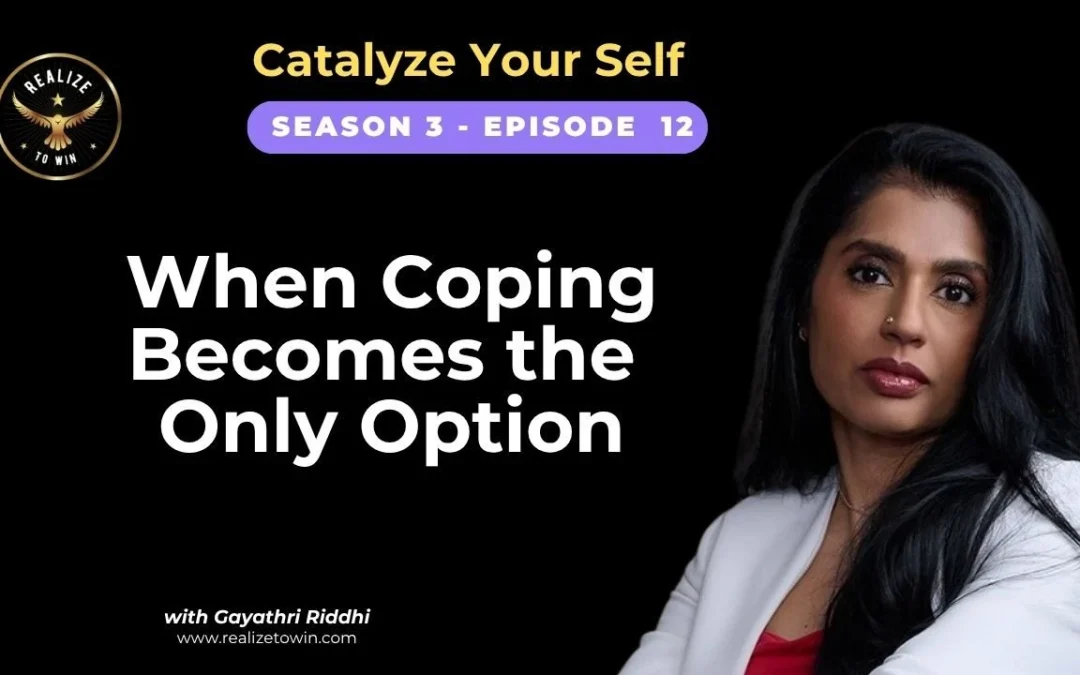
In Season 3 Episode 12 of Catalyze Your Self, When Coping Becomes the Only Option, we stay with this exact tension.

Coping is understood as something that our mind, nervous system, and body may reach for when the current moment feels like more than we have the inner range to fully meet. The episode explores how coping can give us a sense of safety, familiarity, and stability, while also showing us where our conscious presence of mind has become less accessible.

And this is where the return back to conscious presence of mind begins. By recognizing the signal underneath, it. HALT helps us notice where our inner range has narrowed through Hesitation, Avoidance, Lack, or Tiredness. RISE helps us widen the moment enough to return to breath, body, intention, and evaluation. SHIFT helps us move one choice closer to conscious presence and aligned action.

That return may simply be one honest pause before we repeat the familiar response. One breath before we explain. One moment of recognition before we go numb. One question before we defend. One small decision to stay with what is true instead of moving immediately toward what lowers discomfort.


A Reflection

As we move through the coming days, here are a few thoughts to sit with:

Where have we been calling something responsibility, composure, productivity, kindness, or strength, when it may also be coping?

What response has started feeling like the only available route under pressure?

What is that coping response trying to reduce?

Because when coping becomes the only option, the deeper invitation is not to shame the coping. It is to listen closely enough to understand what our mind, our nervous system, and our body have been carrying for us.

Listen to the full episode of Catalyze Your Self, Season 3 Episode 12: When Coping Becomes the Only Option.

When What Matters Gets Ignored

When What Matters Gets Ignored

When What Matters Gets Ignored

There are moments when we do not lose sight of what matters all at once. It happens more quietly than that.

We may still know what we value. We may still know what feels meaningful. We may still know the kind of life we want to build, the kind of person we want to be, the kind of choices that reflect our Self. Nothing about that may have disappeared.

And yet, when pressure has been present for a while, something else can begin moving to the front. What is loud can feel more important than what is true. What is immediate can feel more pressing than what is meaningful. What is familiar can feel safer than what is aligned. What is externally reinforced can begin carrying more weight than the inner reference points we once trusted.

This is where the shift begins. Not because what matters stopped mattering. Because something else started carrying more authority inside us.


When what matters stops guiding the choice

As this season has continued, we have stayed with the internal shifts pressure can create before anything becomes obvious on the outside. We have looked at how inner ground becomes less accessible. How pace can increase without direction. How presence of mind can narrow. How urgency can replace discernment. How obligation can override alignment. How choice can disconnect from intention. How time can feel distorted. How external signals can begin leading. And how understanding can remain partial when truth feels costly.

When those patterns continue, another quiet shift can begin taking shape. Our relationship with what matters can start changing.

We may still speak the language of our values but stop letting them guide us in real time. We may still believe something is important but organize our choices around what feels safer to protect. We may still sense purpose but begin treating it as something we will return to when life gives us more room. We may still know what is true within us but soften it before it becomes visible enough to ask something of us.

And because life keeps moving, we may not notice the distance forming. We only sense that something inside us is no longer carrying the same weight it once did.


The quiet change in authority

There is a difference between knowing what matters and allowing it to lead. That difference becomes especially important under pressure.

When we are internally grounded, our values, beliefs, purpose, and inner truth remain available as reference points. They help us sense what fits and what does not. They help us know when a yes is honest, when a no is necessary, when silence is discernment, and when silence has become self-abandonment. They help us recognize when we are acting from who we are, not only from what the moment is asking us to protect.

Under pressure, that availability can change. Our mind may still know what matters, but our nervous system may be reaching for what feels familiar. Our body may already be bracing before the deeper truth has had enough space to land. Emotion may be signaling that something is off, while cognition is working hard to explain why we can keep going the same way.

And in that internal movement, authority can shift. What is protective may begin leading more than what is honest. What is manageable may begin leading more than what is meaningful. What keeps the outside steady may begin leading more than what keeps us connected to our Self.

We may value honesty and still choose the version of our words that keeps disruption away. We may value respect and still remain in spaces where we have learned to accept being dismissed. We may value peace and still confuse peace with keeping everything undisturbed on the outside. We may value courage and still shape ourselves around what will be easiest for others to receive.

Pressure can also bring older beliefs forward. And these may be beliefs that no longer reflect who we are becoming. Often, they are beliefs shaped by fear, approval, usefulness, protection, or survival. We may value truth and move through life honesty is dangerous. We may value self-respect and yet keep organizing our choices around proving because we belief our worth has to be proven.

This is one of the quieter ways pressure can move us away from ourselves. It does not always make us believe in something new. Sometimes it gives more authority to the beliefs that were already there, waiting underneath our conscious awareness. And when that happens, we may find ourselves living from a belief that protects us, even when it no longer reflects us.

Purpose also can become difficult to feel when pressure has filled too much internal space. Because the deeper reason behind our choices begins to feel less available in real time. We may continue functioning, but the deeper direction of our life starts feeling further away, almost as though it belongs to a different version of us.

And our inner truth becomes harder to stay with under pressure because it is often quieter than expectation, fear, habit, or role, it can be easy to override. We tell ourselves this is not the right time. We convince ourselves that what we feel is less important than what the 


What this episode invites us to notice

In Season 3 Episode 11 of Catalyze Your Self, When What Matters Gets Ignored, we stay with this quiet and important shift. The shift where what matters is still known but no longer leading.

We look at how pressure can change our relationship with Self-Inspiration, the inner anchor that helps us stay connected to values, beliefs, purpose, and inner truth. We explore how what is loud, immediate, familiar, externally reinforced, or comforting can begin carrying more authority than what is meaningful and aligned. And we stay with the deeper consequence of this pattern.

When what matters keeps losing weight inside us, being our own Self can begin to feel unsafe. Because this is not only about priorities. It is about the subtle way pressure can teach us to manage our own Self carefully, instead of living from our Self freely.


A Reflection

As we move through the coming days, here are a few thoughts to sit with:

Where have we lost sight of what matters, even though part of us still know it clearly?

Which inner reference point feels furthest away right now: our values, our beliefs, our purpose, or our inner truth?

And where have we started choosing what feels safest to protect, rather than what feels truest to express?

Because when what matters gets ignored, the deeper loss is not only that something important is overlooked. It is that parts of our own Self begin moving further into the background, quietly enough that we may not notice until our choices no longer feel like they fully belong to us.

Listen to the full episode of Catalyze Your Self, Season 3 Episode 11: When What Matters Gets Ignored.